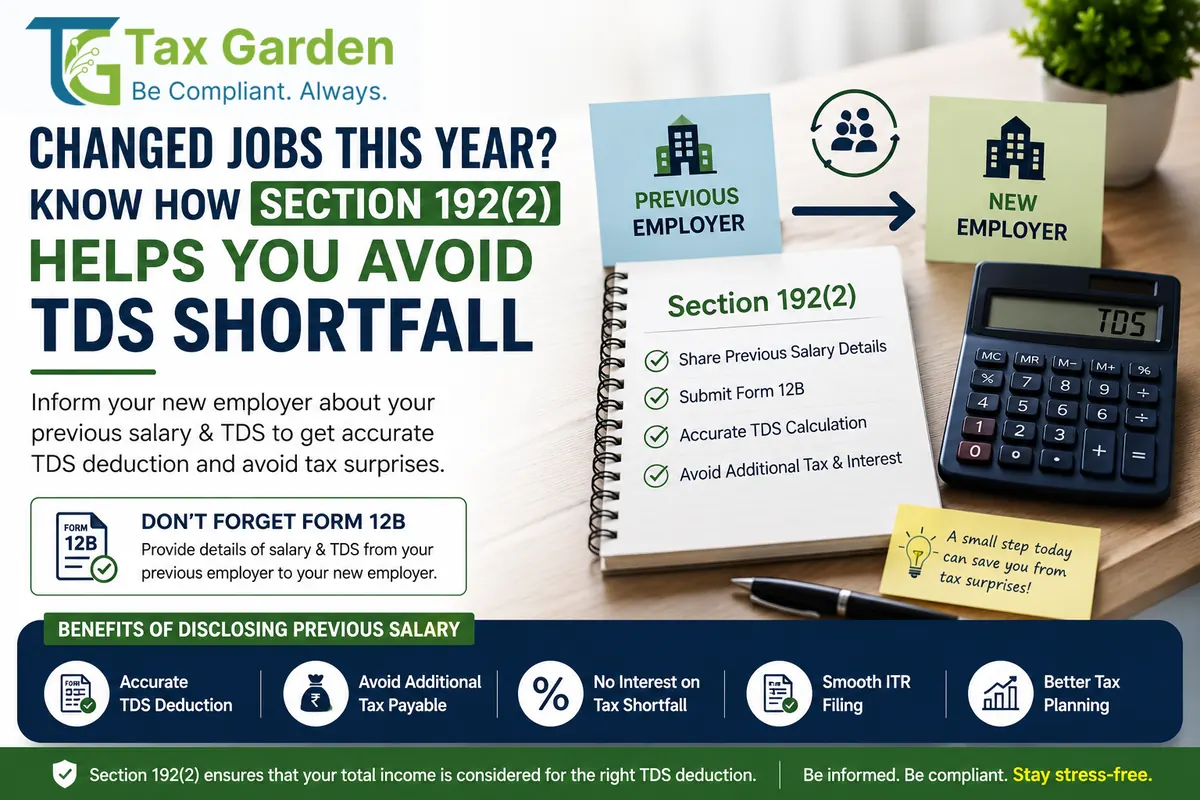
The Problem: Why TDS Shortfalls Happen on Job Changes When you switch employers mid-year, each employer usually deducts TDS on only its own salary. Each one gives you the standard deduction and runs its own salary through the lower slabs (and, under the new regime, the Section 87A rebate). Neither accounts for your total income, so combined TDS falls short and you pay the balance, plus interest under Sections 234B and 234C, when you file. Section 192(2) and Form 12B exist to prevent this.
When you change jobs during the financial year, your salary is split between two employers. Each employer must deduct TDS under Section 192 of the Income Tax Act 1961 on the salary it pays you. The problem arises because each employer computes TDS independently, without knowing about your income from the other employer.
This is a common ITR-season surprise for professionals who switch jobs mid-year. When you file, you find that TDS from both employers is less than the tax on your combined salary, and you owe the balance plus interest under Section 234B (shortfall in advance tax) and Section 234C (deferment of advance tax instalments).
The examples below use FY 2025-26 (AY 2026-27) under the new tax regime, which is the default. For tax year 2026-27 onward, the same mechanism continues under Section 392 of the Income-tax Act 2025, with Form 16 replaced by Form 130.
How TDS Computation Goes Wrong
Priya works with Employer A from April to June 2025 at Rs 1,50,000 a month, then joins Employer B from July 2025 to March 2026 at Rs 2,00,000 a month.
- Employer A (April to June 2025): Paid Rs 4,50,000. After the Rs 75,000 standard deduction, taxable salary is Rs 3,75,000, which is below the Rs 4 lakh nil slab. TDS: nil.
- Employer B (July 2025 to March 2026): Paid Rs 18,00,000. After another Rs 75,000 standard deduction, taxable salary is Rs 17,25,000. Tax is Rs 1,45,000 plus 4% cess = TDS Rs 1,50,800.
Result: Priya got two standard deductions (the Rs 75,000 standard deduction is allowed only once a year), and her first Rs 4.5 lakh was taxed as if it were her only income. Her actual position:
| Item | Amount |
|---|---|
| Total salary (Rs 4,50,000 + Rs 18,00,000) | Rs 22,50,000 |
| Less: standard deduction (once) | Rs 75,000 |
| Taxable income | Rs 21,75,000 |
| Tax: 4-8L Rs 20,000 + 8-12L Rs 40,000 + 12-16L Rs 60,000 + 16-20L Rs 80,000 + 25% of Rs 1,75,000 Rs 43,750 | Rs 2,43,750 |
| Add: 4% cess | Rs 9,750 |
| Total tax | Rs 2,53,500 |
| TDS by both employers | Rs 1,50,800 |
| Shortfall payable at filing | Rs 1,02,700 |
Section 192(2): The Solution, Aggregate Income and Correct TDS
What Section 192(2) Says
Under Section 192(2), where an employee works for more than one employer during the financial year, either one after another or at the same time, the employee may give one employer of their choice the details of salary received from the other employer(s), the TDS deducted on it, and other particulars in the prescribed form. That employer must then take those details into account when deducting TDS under Section 192(1).
In plain language:
- The new employer aggregates your salary from the old employer.
- The new employer computes tax on the total salary for the year and deducts the balance (after the old employer's TDS) over the remaining months.
- Condition: You must give the new employer the details in the prescribed form, Form 12B (Rule 26A of the Income-tax Rules 1962).
The Declaration Requirement: Form 12B
Form 12B is not a one-time document. It is a declaration for the particular financial year and job change. For tax year 2026-27 onward, use the corresponding form prescribed under the Income-tax Rules 2026.
Form 12B: What It Is and What It Contains
Definition and Purpose
Form 12B is an employee's declaration to the new employer of salary received from a previous employer during the same financial year.
The form serves two purposes:
- Inform the new employer of the previous salary and TDS already deducted.
- Enable the new employer to aggregate the total income and deduct the correct TDS for the remaining months.
Information Contained in Form 12B
Take these details from the previous employer's salary slips or Form 16:
- Name, address, PAN and TAN of the previous employer
- Period of employment with that employer
- Salary paid, value of perquisites and profits in lieu of salary
- Allowances exempt under Section 10 (such as HRA, under the old regime)
- Provident fund contribution and professional tax
- Total TDS deducted by the previous employer
Important: Deductions Already Claimed
If your old employer already allowed a deduction, such as Rs 1.5 lakh under Section 80C (old regime), you cannot claim it again at the new employer. The 80C limit is Rs 1.5 lakh for the whole year, not per employer. Tell the new employer what was already allowed so it does not give you the same deduction twice.
Step-by-Step: How Section 192(2) Works When You Switch Jobs
Step 1: Collect Your Old Employer's Salary and TDS Details
Ask the old employer for your final salary slips and full-and-final statement. Form 16 is issued only after the year ends (by 15 June), so you usually rely on salary slips when you fill Form 12B mid-year.
Example: Employer A paid Priya Rs 4,50,000 from April to June 2025 and deducted nil TDS.
Step 2: Prepare Form 12B
When Priya joins Employer B in July 2025, she fills Form 12B with:
- Employer A's name, PAN and TAN
- Salary paid by Employer A: Rs 4,50,000
- Period of employment: 1 April 2025 to 30 June 2025
- TDS deducted by Employer A: nil
Step 3: Submit Form 12B to the New Employer
Submit it as early as possible after joining, so the extra tax is spread over more months. There is no fixed statutory deadline, but the employer can only adjust TDS on salary it has not yet paid for the year, so a declaration given in February or March leaves very little room.
Step 4: New Employer Aggregates Salary and Recomputes TDS
| Item | Amount |
|---|---|
| Tax on combined salary of Rs 22,50,000 (from the table above) | Rs 2,53,500 |
| Less: TDS already deducted by Employer A | Nil |
| TDS to be deducted by Employer B over July 2025 to March 2026 | Rs 2,53,500 (about Rs 28,167 a month) |
Employer B now deducts about Rs 28,167 a month instead of about Rs 16,756 a month (Rs 1,50,800 over 9 months) that it would have deducted on its own salary alone.
Step 5: At ITR Filing, Combine Both Form 16s
When filing the ITR for AY 2026-27, Priya:
- Reports total salary: Rs 22,50,000
- Claims the standard deduction once: Rs 75,000
- Claims TDS credit: nil (Employer A) + Rs 2,53,500 (Employer B) = Rs 2,53,500
- Has no balance tax, so no interest under Sections 234B or 234C.
What Happens If Form 12B Is NOT Submitted
The Shortfall Sits With You
Form 12B is optional. If you do not submit it, the new employer deducts TDS only on the salary it pays. It is not in default for ignoring salary it was never told about.
Result (Priya's example):
- Employer A deducted nil on Rs 4,50,000.
- Employer B deducted Rs 1,50,800 on Rs 18,00,000.
- Combined TDS of Rs 1,50,800 is Rs 1,02,700 less than the tax of Rs 2,53,500.
- The shortfall is payable by the employee as advance tax or self-assessment tax.
Interest Under Sections 234B and 234C
Because the tax still payable after TDS is Rs 10,000 or more, Priya was liable to pay advance tax. If she pays nothing until she files and pays self-assessment tax in July 2026:
- Section 234B: 1% per month (part of a month counts as a full month) on Rs 1,02,700 from 1 April 2026 to July 2026 = 4 months x Rs 1,027 = Rs 4,108.
- Section 234C: additional interest for each missed advance tax instalment (15 June, 15 September, 15 December, 15 March).
See the Section 234B and 234C interest guide for the full instalment-wise computation.
Reconciliation at ITR Filing: Combining Both Form 16s
Form 16 from Both Employers
At ITR time, you receive:
- Form 16 from the old employer: salary and TDS for April to June
- Form 16 from the new employer: salary and TDS for July to March
How to Combine Both Form 16s in Your ITR
When filing your ITR (ITR-1, ITR-2 or ITR-3, depending on your other income), you:
- Declare salary from both employers separately in the salary schedule.
- Claim the standard deduction once, and each Chapter VI-A deduction only once up to its overall limit.
- Claim TDS credit from both employers, after checking both entries in Form 26AS.
- Pay any balance tax with interest as self-assessment tax before filing.
If total TDS exceeds the tax due, you get a refund.
Critical: Do Not Double-Claim Deductions
Mistake example (old regime): Employer A allowed Rs 1.5 lakh under Section 80C for a life insurance premium paid in May. At Employer B you declare Rs 1.5 lakh again for PPF deposits made from July onwards.
The Section 80C limit is Rs 1.5 lakh in total for the year. Even though you actually invested Rs 3 lakh, only Rs 1.5 lakh is deductible. If both employers allowed it, your TDS is too low, and claiming Rs 3 lakh in the ITR leads to a disallowance under Section 143(1).
Correct approach: Claim Rs 1.5 lakh under 80C in the ITR in total, and tell the new employer that the limit is already used up so its TDS is correct.
Common Mistake: Deductions Already Claimed at Old Employer
The Scenario (old regime)
You join a new employer in July. The old employer had already allowed:
- Section 80C (LIC, PPF): Rs 1.5 lakh
- Section 80D (health insurance for self and family, below 60): Rs 25,000
At the new employer, you fill a fresh tax declaration and declare the same amounts again. The new employer's TDS then assumes deductions you cannot actually get twice.
The Consequences
- Tax payable at filing on the excess deductions, with interest under Sections 234B and 234C.
- If you over-claim in the ITR itself: disallowance under Section 143(1) or an addition in scrutiny under Section 143(3), with interest under Section 220(2) if the demand is not paid on time.
- In an assessment, a wrong claim can also attract a penalty under Section 270A of 50% of the tax on under-reported income (200% where it is misreporting). Section 271(1)(c) no longer applies to assessment years from AY 2017-18 onward.
How to Avoid This
At the new employer, during onboarding:
- Get your salary slips or full-and-final statement from the old employer.
- Note the deductions already allowed there.
- In the new employer's tax declaration, declare only the unused part of each limit.
Simultaneous Employment: Two Jobs at the Same Time
The Different Scenario
Section 192(2) covers both sequential employment (switching jobs) and simultaneous employment, where you draw salary from two employers at the same time.
Payments for freelance or consulting work are not salary. They are covered by other TDS sections (such as Section 194J) and are taxed as business or professional income, so they cannot be put into Form 12B.
How Section 192(2) Works for Simultaneous Employment
- Choose one employer to receive the declaration.
- Give it details of salary and TDS from the other employer.
- That employer aggregates both salaries and deducts TDS on the total, after allowing for TDS by the other employer.
Practical Example
- Employer A: salary Rs 20 lakh per year.
- Employer B: salary Rs 5 lakh per year.
- Total salary: Rs 25 lakh.
If you do not inform Employer A about Employer B:
- Each employer deducts TDS on its own salary and each allows a standard deduction.
- Combined TDS is less than the tax on Rs 25 lakh.
- You pay the balance with interest at ITR filing.
If you submit a declaration to Employer A:
- Employer A computes tax on Rs 25 lakh and deducts it after allowing for Employer B's TDS.
- At ITR time, little or no tax is left to pay.
Tax Compliance for Simultaneous Employment
- Declare both salaries to at least one employer under Section 192(2).
- File your ITR showing both salaries and claim TDS credit from both employers.
- Pay advance tax if your tax payable after TDS for the year is Rs 10,000 or more.
Summary
Section 192(2) and Form 12B protect salaried employees from a TDS shortfall when they switch jobs or hold two jobs. The key is timely disclosure to the new employer and claiming each deduction only once at ITR time.
Internal Linking and Related Resources
For more detailed guidance on related topics:
- Employer's perspective on TDS deduction: TDS on Salary: Section 192 & Employer Guide
- How to read and use Form 16 for ITR filing: How to Read Form 16 & File Your ITR as a Salaried Employee
- Tax slabs and rates for FY 2026-27: Income Tax Slab Rates FY 2026-27 (AY 2027-28)
- Transfer or withdraw your PF when switching jobs: EPF Withdrawal Tax Rules: 5-Year Rule and TDS
Sources
- Income Tax Act, 1961: Sections 192(1), 192(2), 234B, 234C, 270A
- Income-tax Rules, 1962: Rule 26A and Form 12B
- Income-tax Act, 2025: Section 392 (TDS on salary from tax year 2026-27)
- Finance Act, 2025: new regime slabs and Section 87A rebate for FY 2025-26