CTC vs Gross vs Take-Home: Definitions
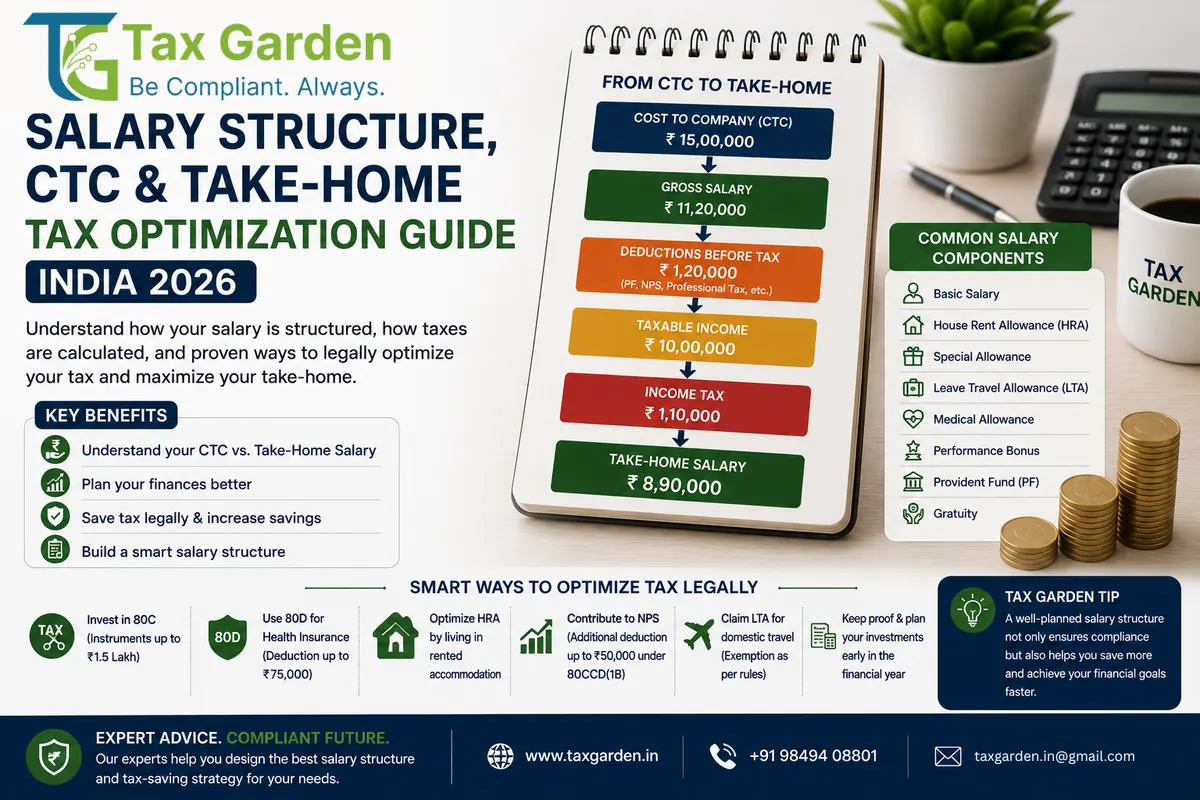
CTC (Cost to Company)
Total cost incurred by the employer for the employee. Includes:
- Basic salary and dearness allowance (DA)
- Allowances (HRA, LTA, special allowance)
- Employer PF contribution (12%)
- Gratuity provision
- Group medical and life insurance premiums
- Employer NPS contribution, if offered
Usually not part of the employee's taxable income: employer PF (within limits), gratuity provision, group insurance premiums. Employer NPS is added to salary but then deducted under Section 80CCD(2).
Gross Salary
CTC minus employer-side costs such as employer PF, gratuity provision and insurance premiums. This is what your salary slip shows before deductions.
Formula: Gross = CTC - (Employer PF + Gratuity provision + Insurance)
Take-Home Pay
Gross salary minus:
- Income tax (TDS)
- Employee PF (12% of basic + DA, or of the statutory wage ceiling if your employer restricts it: Rs 25,000 a month from 17 September 2026, Rs 15,000 before that)
- Professional tax, in states that levy it
Formula: Take-home = Gross - TDS - Employee PF - Professional tax
Worked Example: Rs 15 Lakh CTC (New Regime, FY 2025-26)
| Item | Amount (Rs) |
|---|---|
| CTC | 15,00,000 |
| Less: employer PF (12% of Rs 15,000 x 12) | 21,600 |
| Less: gratuity provision (4.81% of basic of Rs 6,00,000) | 28,860 |
| Gross salary | 14,49,540 |
| Less: standard deduction | 75,000 |
| Taxable income | 13,74,540 |
| Tax: Rs 20,000 + Rs 40,000 + 15% of Rs 1,74,540 | 86,181 |
| Add: 4% cess | 3,447 |
| Income tax | 89,628 |
| Employee PF | 21,600 |
| Annual take-home (no professional tax assumed) | 13,38,312 (about Rs 1,11,526 a month) |
This example uses FY 2025-26, when the PF wage ceiling was Rs 15,000 for the whole year. From 17 September 2026 the ceiling is Rs 25,000 (S.O. 5109(E)), so where an employer restricts PF to the ceiling, a full year at the new ceiling means employer PF and employee PF of Rs 36,000 each (12% of Rs 25,000 x 12) instead of Rs 21,600.
Salary Components and Tax Treatment
Basic Salary
- 100% taxable
- Used to calculate HRA exemption, PF and gratuity
- Since the Labour Codes took effect on 21 November 2025, allowances above 50% of total remuneration are added back to "wages" for PF and gratuity, so a very low basic no longer cuts those costs
House Rent Allowance (HRA)
Section 10(13A): Exemption available ONLY in the old regime.
Exemption is the lowest of:
- Actual HRA received
- 50% of (basic + DA) in Delhi, Mumbai, Kolkata and Chennai; 40% in other cities (for tax year 2026-27 the Income-tax Rules 2026 add Bengaluru, Hyderabad, Pune and Ahmedabad to the 50% list)
- Actual rent paid minus 10% of (basic + DA)
Example (Delhi, basic Rs 6L, DA Rs 1L, HRA Rs 3L, rent Rs 3.5L):
- Actual HRA: Rs 3L
- 50% of (Rs 6L + Rs 1L) = Rs 3.5L
- Rent minus 10% of (Rs 6L + Rs 1L) = Rs 3.5L - Rs 0.7L = Rs 2.8L
- Exempt: Rs 2.8L (lowest)
New regime: No exemption. Entire HRA taxable.
Leave Travel Allowance (LTA)
Section 10(5): Exemption for travel within India, for two journeys in a block of four calendar years.
Exemption limit: the actual fare for the employee and family, capped at:
- Economy airfare of the national carrier by the shortest route, for air travel
- AC first-class rail fare by the shortest route, where the places are connected by rail
- Hotel stay, food and sightseeing are not covered
Requirements:
- Travel within India only (international travel not exempt)
- Covers self, spouse, dependent children (only two children born after 1 October 1998) and dependent parents and siblings
- Encashment without travel: fully taxable
Blocks: The current block is calendar years 2026 to 2029 (the previous block was 2022 to 2025). A journey not used in a block can be carried over to the first calendar year of the next block.
New regime: No exemption. LTA is fully taxable.
Transport and Conveyance Allowances
- Conveyance allowance for official duties (Section 10(14)(i)): exempt to the extent actually spent on official travel, under both regimes
- Transport allowance for employees with disabilities (Rule 2BB): up to Rs 3,200 a month, under both regimes
- Children's education allowance (Rs 100 a month per child) and hostel allowance (Rs 300 a month per child), for up to two children: old regime only
- A general "fuel allowance" paid as a fixed amount without official use is taxable
Meal Vouchers/Food Coupons
Meals provided through non-transferable paid vouchers usable only at eating joints are tax-free up to Rs 50 per meal for FY 2025-26 (Rule 3(7)(iii) of the 1962 Rules), and up to Rs 200 per meal from tax year 2026-27 under the Income-tax Rules 2026.
Conditions:
- Paid vouchers, not cash
- Usable only for food and non-alcoholic beverages
- Available under both regimes
Example (FY 2025-26): 2 meals a day x 22 working days x Rs 50 = Rs 2,200 a month exempt. From tax year 2026-27, the same pattern at Rs 200 a meal gives Rs 8,800 a month.
Special Allowance
- 100% taxable
- Often the balancing figure in a CTC structure
Dearness Allowance (DA)
- Fully taxable
- Counts as salary for HRA and, where it forms part of retirement benefits, gratuity
Flexible Benefit Plan (FBP)
FBP allows the employer to offer a pool of benefits. The employee chooses how to allocate it.
How FBP Works
Employer declares a pool (for example, Rs 2 lakh a year). Employee allocates:
- Rs 50,000 to LTA
- Rs 30,000 to telephone and internet reimbursement
- Rs 26,400 to meal vouchers
- Balance as taxable allowance
Critical Distinction: Allowance vs Reimbursement
FBP pitfall: If a component is paid as a fixed allowance without bills, the entire amount is taxable.
FBP Components (Tax-Exempt if Properly Structured)
- LTA: within the fare limits above (old regime only)
- Telephone and internet: reimbursement of actual bills
- Meal vouchers: within the per-meal limit
- Books and periodicals, uniform: reimbursement with bills, as per employer policy
NPS Employer Contribution: Section 80CCD(2)
Most overlooked tax benefit for salaried employees.
Employer contribution to your Tier-1 NPS account is deductible up to 14% of (basic + DA) under the new regime (from FY 2024-25) and 10% under the old regime for private sector employees.
Key Benefits
- Deductible under Section 80CCD(2), outside the Rs 1.5 lakh Section 80C limit
- Available in both regimes (with the different limits above)
- Employer contributions to PF, NPS and superannuation together above Rs 7.5 lakh a year are taxable as a perquisite
- Your own additional contribution of up to Rs 50,000 under Section 80CCD(1B) is deductible only in the old regime
Calculation
Basic Rs 6L, DA Rs 1L
- Employer NPS at 14% (new regime): Rs 98,000, saving Rs 30,576 at the 30% slab plus cess
- Employer NPS at 10% (old regime): Rs 70,000, saving Rs 21,840 at the 30% slab plus cess
Gratuity and PF
Gratuity (Section 10(10))
- Employer-funded; nothing is deducted from your salary
- Exemption for non-government employees: up to Rs 20 lakh in a lifetime (since 29 March 2018)
- Payable on leaving after 5 years of continuous service (1 year for fixed-term employees under the Labour Codes from 21 November 2025)
Provident Fund
- Employee contribution: 12% of basic + DA (or of the wage ceiling: Rs 25,000 a month from 17 September 2026, Rs 15,000 before that, raised by S.O. 5109(E))
- Employer contribution: 12%, part of which goes to the pension scheme (EPS)
Tax treatment:
- Employee contribution: deductible under Section 80C (old regime only)
- Employer contribution: not taxable, within the Rs 7.5 lakh combined cap
- Interest: tax-free, except interest on your own contributions above Rs 2.5 lakh a year (Rs 5 lakh where the employer does not contribute), which is taxable
- Withdrawal after 5 years of continuous service: exempt under Section 10(12)
Old Regime vs New Regime: Worked Comparison
Scenario: Rs 20 Lakh CTC, Delhi, FY 2025-26
Salary Structure:
| Component | Amount (Rs) |
|---|---|
| Basic | 8,00,000 |
| HRA (rent paid Rs 4,50,000) | 4,00,000 |
| LTA (used for an economy flight of Rs 50,000) | 50,000 |
| Special allowance | 5,83,520 |
| Meal vouchers (Rs 50 x 2 meals x 22 days x 12) | 26,400 |
| Employer NPS (10% of basic) | 80,000 |
| Employer PF (12% of Rs 15,000 x 12) | 21,600 |
| Gratuity provision (4.81% of basic) | 38,480 |
| CTC | 20,00,000 |
Salary for tax (basic, HRA, LTA, special allowance, employer NPS): Rs 19,13,520. Meal vouchers, employer PF and gratuity provision are not taxable. Employer PF here uses the Rs 15,000 ceiling that applied throughout FY 2025-26; the ceiling is Rs 25,000 from 17 September 2026.
Old Regime Calculation
| Step | Amount (Rs) |
|---|---|
| Salary | 19,13,520 |
| Less: HRA exemption (lowest of 4,00,000; 50% of basic 4,00,000; rent minus 10% of basic 3,70,000) | 3,70,000 |
| Less: LTA exemption | 50,000 |
| Less: standard deduction | 50,000 |
| Less: Section 80C (employee PF 21,600 + PPF/ELSS 1,28,400) | 1,50,000 |
| Less: Section 80D (self and family) | 25,000 |
| Less: Section 80CCD(1B) (own NPS) | 50,000 |
| Less: Section 80CCD(2) (employer NPS) | 80,000 |
| Taxable income | 11,38,520 |
| Tax: 12,500 + 1,00,000 + 30% of 1,38,520 | 1,54,056 |
| Add: 4% cess | 6,162 |
| Total tax | 1,60,218 |
New Regime Calculation
| Step | Amount (Rs) |
|---|---|
| Salary | 19,13,520 |
| Less: standard deduction | 75,000 |
| Less: Section 80CCD(2) (employer NPS) | 80,000 |
| Taxable income | 17,58,520 |
| Tax: 20,000 + 40,000 + 60,000 + 20% of 1,58,520 | 1,51,704 |
| Add: 4% cess | 6,068 |
| Total tax | 1,57,772 |
Comparison
| Regime | Tax |
|---|---|
| Old regime | Rs 1,60,218 |
| New regime | Rs 1,57,772 |
Conclusion: Even with HRA, LTA, full 80C, 80D and own NPS, the new regime is marginally cheaper (by Rs 2,446) at this salary. Add a home loan on a self-occupied house with Rs 2 lakh interest under Section 24(b), and old-regime taxable income falls to Rs 9,38,520: tax becomes Rs 1,04,212, about Rs 53,560 less than the new regime. Run both computations on your own numbers.
ESOP: Not a Salary Optimization Tool
ESOP (Employee Stock Option Plan) benefits are taxed as a perquisite, not as a tax-saving salary component.
Tax Treatment
- On exercise/allotment: Perquisite = FMV on the exercise date minus exercise price (taxed as salary)
- On sale: Capital gain = sale price minus that FMV
Example:
- Exercise price: Rs 100
- FMV on exercise: Rs 250
- Perquisite: Rs 150 per share (at the 30% slab plus cess, tax of Rs 46.80)
- Sell at Rs 400: capital gain = Rs 400 - Rs 250 = Rs 150 per share. For listed Indian shares held more than 12 months, this is long-term (12.5% above the yearly Rs 1.25 lakh exemption); for unlisted or foreign shares the long-term period is 24 months.
Salary structure impact: ESOPs add to taxable income. They are not a deduction tool.
Reimbursement vs Allowance: Critical Distinction
Reimbursement (Tax-Free)
- Employer repays actual expenses incurred for official purposes, against bills
- Example: business travel of Rs 50,000, reimbursed against bills, is not income
Allowance (Taxable)
- Fixed amount given regardless of expense
- Added to gross salary
- Taxable except specifically exempt components (HRA and LTA in the old regime, official conveyance)
HR Mistake: FBP as Allowance Without Bills
Company declares Rs 2,00,000 "flexible allowance" with no bill submission.
Tax consequence: Entire Rs 2,00,000 is taxable salary. At the 30% slab plus cess, that is Rs 62,400 of tax.
Correct approach: Each benefit properly classified:
- LTA: claim with travel tickets (old regime)
- Telephone and internet: reimbursement with bills
- Meal vouchers: within the per-meal limit
Common HR Mistakes in Salary Structuring
Mistake 1: Keeping Basic Too Low
Error: HR sets basic at 25% to 30% of CTC to minimise PF and gratuity.
Consequence: Lower HRA exemption (50% or 40% of basic), and since 21 November 2025 the Labour Codes add allowances above 50% of remuneration back into wages for PF and gratuity anyway.
Fix: Keep basic + DA at around 50% of total pay.
Mistake 2: Not Utilizing LTA
Error: Employee does not travel in the block.
Consequence: LTA paid becomes fully taxable.
Fix: Plan two journeys in each four-year block (current block 2026 to 2029).
Mistake 3: Declaring FBP as Allowance Without Process
Error: FBP pool declared as "flexible allowance," no bills required.
Consequence: Entire amount taxable.
Fix: Establish an FBP policy with bill submission and approval.
Mistake 4: Ignoring Employer NPS Contribution
Error: NPS presented only as "pension," not as a tax benefit.
Consequence: Employee misses a deduction of up to 14% of basic + DA in the new regime.
Fix: Ask HR to route part of the special allowance to employer NPS under Section 80CCD(2).
Mistake 5: Using ESOP as Tax-Saving Tool
Error: Increasing the ESOP component thinking it reduces income tax.
Consequence: ESOP is a perquisite and increases taxable income.
Fix: Treat ESOPs as a wealth-building tool, not a tax-saving tool.
Compliance Checklist
- Verify CTC vs gross vs take-home in your salary slip
- Confirm HRA exemption calculation (metro or non-metro rate)
- Claim LTA with travel proof (old regime)
- Verify meal voucher limit (Rs 50 per meal for FY 2025-26, Rs 200 from tax year 2026-27)
- Check FBP policy: allowance vs reimbursement
- Confirm employer NPS contribution (up to 14% new regime, 10% old regime)
- Review Section 80C investments if you choose the old regime
- Tell your employer your regime at the start of the year; a salaried employee can make the final choice when filing the ITR
- File ITR-1 or ITR-2 as applicable, matching salary to Form 16
Source: Income-tax Act 1961 (Sections 10(5), 10(10), 10(12), 10(13A), 10(14), 17, 80C, 80CCD, 115BAC); Income-tax Rules 1962 (Rules 2A, 2B, 2BB, 3); Finance (No. 2) Act 2024; Finance Act 2025; Income-tax Rules 2026 for tax year 2026-27; Code on Wages 2019 and Code on Social Security 2020 (in force from 21 November 2025).