Belated, Revised, and Updated ITR: Complete Guide for AY 2026-27
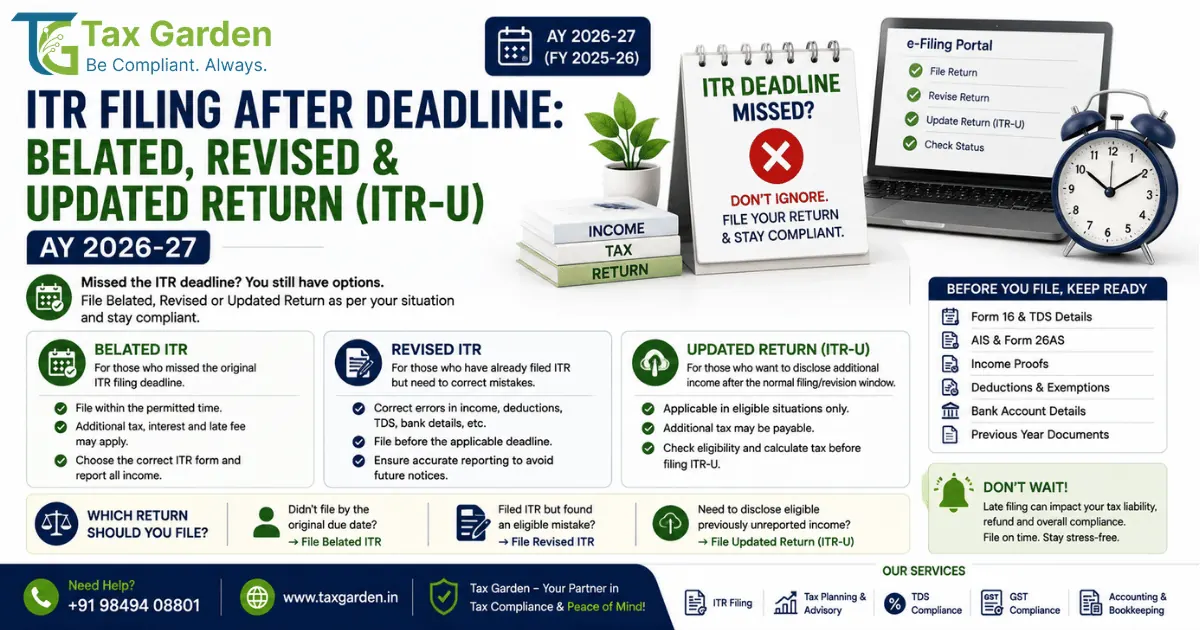
Missing the ITR filing deadline does not mean you lose the right to file. The Income Tax Act provides three options after the original due date passes: belated return, revised return, and updated return. Each has different deadlines, different costs, and different consequences for your tax position.
This guide covers all three options as they apply to Assessment Year 2026-27 (income earned in FY 2025-26), including the transition to the Income Tax Act 2025 for future tax years.
Original ITR Due Dates for AY 2026-27
Deadline Timeline
Key ITR Deadlines : AY 2026-27 (FY 2025-26)
Filing windows from original due date through updated return. Missing each deadline reduces your options and increases cost.
Original ITR Due Date
ITR-1 and ITR-2 filers and other cases without business or professional income
Non-Audit Business Due Date
Business or professional income without tax audit (ITR-3, ITR-4), Finance Act 2026
Audit Cases Due Date
Businesses and professionals requiring tax audit under Section 44AB (extended from Oct 31 by CBDT Circular 07/2026)
Transfer Pricing Due Date
Businesses requiring transfer pricing report under Section 92E
Belated Return Deadline
Section 139(4) : late fee of Rs 1,000 or Rs 5,000; losses cannot be carried forward
Revised Return Deadline
Section 139(5) : correct mistakes; Section 234I fee if filed after Dec 31, 2026
Updated Return (ITR-U) Deadline
Section 139(8A) : additional tax of 25% to 70% depending on delay; 48 months from end of AY
Source: Income Tax Act 1961: Sections 139(1), 139(4), 139(5), 139(8A), 234F, 234I; Finance Act 2025; Finance Act 2026
Before discussing late filing options, here are the original due dates for FY 2025-26 (AY 2026-27):
| Taxpayer | Due date |
|---|---|
| ITR-1 and ITR-2 filers, and others without business or professional income | July 31, 2026 |
| Business or professional income, no tax audit (ITR-3, ITR-4), and partners of non-audit firms | August 31, 2026 |
| Tax audit cases, companies, partners of audited firms | November 21, 2026 (extended by CBDT Circular 07/2026 dated 28 September 2026 from October 31) |
| Transfer pricing report cases (Section 92E) | November 30, 2026 |
If you file by these dates, no late fee or interest applies on the return filing itself.
Belated Return: Section 139(4)
What It Is
A belated return is an ITR filed after the original due date but within the extended deadline permitted by law. For AY 2026-27, the belated return deadline is December 31, 2026, or before the completion of assessment, whichever is earlier.
Who Can File
Any person who was required to file an original return but failed to do so by the due date can file a belated return. This includes:
- Salaried individuals who missed July 31, 2026
- Non-audit business owners and professionals who missed August 31, 2026
- Audit cases that miss November 21, 2026
- Any taxpayer who was not required to file but wants to file (for claiming a refund, for example)
Penalty for Belated Filing
| Total income | Late fee under Section 234F |
|---|---|
| Up to Rs 5 lakh | Rs 1,000 |
| Above Rs 5 lakh | Rs 5,000 |
No fee applies if you were not required to file (income below the basic exemption limit and no other mandatory filing condition).
The late fee applies to anyone required to file, regardless of whether any tax is due, and is paid before the return is submitted.
Interest on Unpaid Tax: Section 234A
If you have any outstanding tax liability (self-assessment tax), you must also pay interest at 1% per month (or part of a month) from the original due date until the date of filing the belated return. This is in addition to the late fee.
For example, if you were an ITR-2 filer (due date July 31, 2026), owed Rs 50,000 in tax and filed a belated return on October 15, 2026, you would pay:
- Late fee: Rs 5,000 (assuming income above Rs 5 lakh)
- Interest under 234A: Rs 50,000 x 1% x 3 months (August, September, October) = Rs 1,500
- Total additional cost: Rs 6,500
What You Lose by Filing Late
Filing a belated return has real consequences beyond the late fee:
-
Cannot carry forward losses. If you have business losses (Section 72), speculation losses (Section 73), capital gains losses (Section 74), or losses from owning and maintaining racehorses (Section 74A), these cannot be carried forward if you file a belated return. The loss is permanently lost for set-off against future income.
-
Cannot carry forward unabsorbed depreciation? No, unabsorbed depreciation under Section 32(2) can still be carried forward even in a belated return. This is a common misconception.
-
House property loss. Loss from house property (Section 71B) can be carried forward in a belated return. Only the losses listed above are blocked.
-
Interest under Section 234A applies from the original due date, not the belated filing date.
-
Prosecution risk. Wilful failure to file can be prosecuted under Section 276CC. Punishment is 6 months to 7 years' rigorous imprisonment where the tax sought to be evaded exceeds Rs 25 lakh, and 3 months to 2 years in other cases. Filing the return before the end of the assessment year, or a small net tax payable, generally keeps you out of its reach.
How to File a Belated Return
The process is identical to filing an original return on the income tax e-filing portal:
- Log in to incometax.gov.in/iec/foportal/.
- Select the correct ITR form (ITR 1, ITR 2, ITR 3, ITR 4, etc.).
- Under "Return Filing Section," select Section 139(4) (belated return).
- Fill in all income details, deductions, and tax payments.
- Pay any outstanding self-assessment tax, late fee under Section 234F, and interest under Section 234A before filing.
- Verify the return (Aadhaar OTP, DSC, or send signed ITR-V to CPC Bengaluru within 30 days).
The ITR utility calculates the late fee and interest. Pay them before submitting, otherwise the unpaid amount comes back as a demand in the Section 143(1) intimation.
Revised Return: Section 139(5)
What It Is
A revised return replaces a previously filed return (original or belated) when you discover an omission, mistake, or wrong statement. The revised return completely supersedes the earlier return.
Deadline for AY 2026-27
For FY 2025-26 (AY 2026-27), a revised return can be filed before March 31, 2027, or before the completion of assessment, whichever is earlier.
When You Need to Revise
Common reasons for filing a revised return:
- Forgot to report income from a second employer, freelance work, or bank interest
- Claimed a wrong deduction amount (Section 80C, 80D, HRA, etc.)
- Selected the wrong ITR form
- Made errors in bank account details for refund credit
- Missed reporting foreign assets or income
- TDS mismatch between Form 26AS/AIS and the filed return
- Incorrectly reported capital gains (wrong holding period, wrong exemption)
Number of Revisions Allowed
There is no statutory limit on the number of revised returns you can file within the deadline. Each revised return replaces the previous one. However, frequent revisions may attract scrutiny from the Assessing Officer.
How to File
- Log in to incometax.gov.in/iec/foportal/.
- Start a new return for AY 2026-27.
- Under "Return Filing Section," select Section 139(5) (revised return).
- Enter the original return acknowledgment number and the date of filing of the return being revised.
- Correct the relevant fields.
- Submit and verify.
A revised return filed on or before December 31, 2026 carries no fee. If it is filed after December 31, 2026, the new Section 234I (inserted by the Finance Act 2026) charges Rs 1,000 where total income is up to Rs 5 lakh and Rs 5,000 otherwise. If the revision results in additional tax liability, you must pay the tax along with interest under Section 234B (advance tax) and Section 234C (installment defaults) as applicable.
Important: Can You Revise a Belated Return?
Yes. A belated return filed under Section 139(4) can be revised under Section 139(5), provided the revision is filed before March 31, 2027, or before the completion of assessment.
Updated Return (ITR-U): Section 139(8A)
What It Is
The updated return was introduced by the Finance Act 2022. It allows any taxpayer to file or update their return within the Section 139(8A) updated return window of 48 months from the end of the relevant assessment year, even after the belated and revised return deadlines have passed.
For AY 2026-27, the updated return can be filed until March 31, 2031 (48 months from March 31, 2027).
Who Can File
Any person can file an updated return, whether or not they filed an original, belated, or revised return. However, an updated return:
- Cannot reduce total tax liability
- Cannot increase a refund
- Cannot result in a return of loss or increase an existing loss
- Cannot be filed if assessment, reassessment, or revision proceedings are pending or completed for that year
- Cannot be filed if search or survey proceedings have been initiated
- Cannot be filed if information has been received under a DTAA and relates to an asset located outside India
- Only one updated return can be filed per assessment year
Additional Tax Payable
The cost of filing an updated return increases with delay. The additional tax under Section 140B is a percentage of the aggregate tax and interest payable on the updated return:
| Filed within (from end of AY) | Last date for AY 2026-27 | Additional tax |
|---|---|---|
| 12 months | March 31, 2028 | 25% |
| 24 months | March 31, 2029 | 50% |
| 36 months | March 31, 2030 | 60% |
| 48 months | March 31, 2031 | 70% |
The 36-month and 48-month windows were added by the Finance Act 2025 (Budget 2025). Previously, the limit was 24 months.
When to Use ITR-U
The updated return is your last resort. Use it when:
- You missed both the original and belated return deadlines
- You filed a return but later discovered unreported income (bank FD interest, capital gains, rental income)
- Your AIS/TIS shows income you did not report, and you want to correct it before the department acts
How to File
- Log in to incometax.gov.in/iec/foportal/.
- Select ITR-U (available as a specific form option).
- Select the reason for filing the updated return from the dropdown (income not reported, wrong exemption claimed, wrong rate applied, etc.).
- Enter all income details for the relevant year.
- Pay the full tax due plus additional tax under Section 140B before filing.
- Submit and verify.
You must pay the entire tax, interest, and additional tax before submitting ITR-U. The portal will not accept the return without payment.
Belated vs. Revised vs. Updated: Quick Comparison
| Belated (139(4)) | Revised (139(5)) | Updated (139(8A)) | |
|---|---|---|---|
| Deadline for AY 2026-27 | December 31, 2026 | March 31, 2027 | March 31, 2031 |
| Cost | Section 234F fee Rs 1,000 or Rs 5,000, plus 234A interest | Nil up to December 31, 2026; Section 234I fee Rs 1,000 or Rs 5,000 after that | Additional tax of 25% to 70% of tax and interest |
| Can claim refund or loss? | Yes (but most losses cannot be carried forward) | Yes | No |
| How many times? | Once | No statutory limit within the deadline | Once per year |
Transition to Income Tax Act 2025: Section 263
For income earned from April 1, 2026 onward (Tax Year 2026-27), the Income Tax Act 2025 applies. All return types are consolidated under Section 263:
- Section 263(1): Original return
- Section 263(4): Belated return
- Section 263(5): Revised return
- Section 263(6): Updated return
Key changes under the new Act:
-
Revised return deadline extended. The time limit for filing a revised return has been increased from 9 months to 12 months from the end of the relevant tax year.
-
Fee on late revised returns. A fee under Section 428(b) is levied on revised returns filed beyond 9 months from the end of the relevant tax year. The Finance Act 2026 made the matching change in the 1961 Act (12-month window plus the Section 234I fee), so it already applies to AY 2026-27.
-
Updated return window. Extended to 48 months from the end of the financial year succeeding the relevant tax year, consistent with the Budget 2025 amendment.
-
Section number mapping: Section 139 of the old Act maps to Section 263 of the new Act.
For AY 2026-27 returns (FY 2025-26 income), the old Section 139 provisions still apply because the income was earned before April 1, 2026.
Common Mistakes to Avoid
-
Assuming no return is needed because TDS was deducted. TDS does not substitute for ITR filing. If your gross total income exceeds the basic exemption limit, you must file even if tax has been fully deducted at source. Filing late attracts the Section 234F fee regardless.
-
Missing the December 31 deadline for belated returns. If you have not filed at all, after December 31 your only option is the updated return (ITR-U) with 25% additional tax. The cost difference between a Rs 5,000 late fee and a 25% additional tax surcharge is substantial.
-
Filing a belated return and expecting to carry forward losses. Business losses and capital gains losses filed after the due date are permanently lost. If you have significant losses, file on time.
-
Not paying tax before filing ITR-U. The portal rejects an updated return if the tax is not paid in advance. Calculate your tax, interest, and additional tax, pay through e-Pay Tax (Challan 280), and then file.
-
Confusing the revised return with an updated return. A revised return replaces a filed return by March 31, 2027 (fee-free up to December 31, 2026). An updated return is for correcting or filing after all other deadlines have passed, at a 25% to 70% premium. Always check if the revised return window is still open before using ITR-U.
Filing Checklist for AY 2026-27
- Check if the original due date (July 31, 2026, August 31, 2026 or November 21, 2026) has passed.
- If yes, determine whether you need a belated return, revised return, or updated return.
- Download your Form 26AS, AIS, and TIS from the income tax portal. Cross-check all reported income.
- Calculate self-assessment tax, late fee, and interest before starting the return.
- Pay all dues through e-Pay Tax (Challan 280) and note the challan details.
- Select the correct filing section on the portal (139(4) for belated, 139(5) for revised, ITR-U for updated).
- For revised returns, keep the original return acknowledgment number ready.
- Verify the return within 30 days of filing.
Tax Garden Handles Your ITR Filing
Tax Garden's ITR filing service track every deadline, cross-verify your income against Form 26AS, AIS, and TIS, and file your return before the due date. If a revision is needed, we file it within the statutory window.
For related topics, see our guides on common ITR filing mistakes, ITR 1 Sahaj filing guide, how to read Form 16 and file ITR, what happens if you miss the ITR deadline, and AIS vs Form 26AS vs TIS.
Frequently Asked Questions
Is there a fee for filing a revised return for AY 2026-27?
A revised return for AY 2026-27 can be filed until 31 March 2027. If it is filed after 31 December 2026, a fee under Section 234I applies: Rs 1,000, or Rs 5,000 if total income exceeds Rs 5 lakh. Revising earlier avoids that fee. Any extra tax that results from the revision must be paid with applicable interest before you file.
What is the late fee if I file my AY 2026-27 ITR after the due date?
The late fee under Section 234F is Rs 5,000, reduced to Rs 1,000 if total income does not exceed Rs 5 lakh. No fee applies if income is below the basic exemption limit and filing is not otherwise compulsory. Interest under Section 234A at 1% per month on unpaid tax is charged in addition, running from the original due date to the date of filing.
Can I carry forward capital losses if I file a belated return?
No. Business losses, speculation losses, capital losses and losses from owning racehorses can be carried forward only if the return is filed by the original due date. A belated return filed by 31 December 2026 can still set off these losses against other income of the same year. Loss from house property and unabsorbed depreciation remain eligible for carry forward even in a belated return.
How much additional tax is payable on an ITR-U for AY 2026-27?
The additional tax is a percentage of the aggregate tax and interest due on the updated return: 25% if filed within 12 months from the end of the assessment year, 50% within 24 months, 60% within 36 months and 70% within 48 months. For AY 2026-27, the assessment year ends on 31 March 2027, so the 25% slab runs until 31 March 2028.
Can I file ITR-U to claim a refund or report a loss I missed?
No. An updated return can only increase your tax liability. It cannot be used to claim or increase a refund, reduce tax already assessed, declare a loss or increase an existing loss. If you missed a deduction or refund claim for AY 2026-27, use a belated return by 31 December 2026 or a revised return by 31 March 2027 instead.
Work with the Trusted Tax & Compliance Services in Kondapur, Hyderabad - Tax Garden for expert GST filing, ITR, TDS, ROC, and startup compliance support.
Frequently Asked Questions: Tax Services in Kondapur & Hyderabad
What makes Tax Garden a preferred GST consultant in Kondapur?
Tax Garden is ISO 9001:2015 certified and backs every engagement with Kavach, our ₹50,000 error-protection cover. Published monthly plans, with the fee shown before you sign up, make us a compliance partner for startups and SMEs in Kondapur's HITEC City corridor.
Why is Tax Garden a trusted tax compliance partner in Hyderabad?
Trust comes from three pillars at Tax Garden. First, transparency: you know the exact fee before you sign up, and it never changes mid-year. Second, certified expertise: our compliance team is qualified, and the firm holds ISO 9001:2015 certification. Third, accountability: Kavach, our unique error-protection plan, covers up to ₹50,000 in service charges for any clerical mistake made by our team.
Is there a reliable tax consultant near me in Kondapur?
Yes. Tax Garden's office is in Kondapur itself (CWS One Building, Hanuman Nagar). You can book an in-person consultation or get everything done fully online via WhatsApp and our client portal. We serve walk-in clients by appointment and remote clients across all of Hyderabad and Telangana.
I want a friendly tax expert who explains things clearly. Is that Tax Garden?
Yes. Every client can reach our team on WhatsApp and gets plain-language explanations of what is filed and why, plus reminders before every deadline. No jargon, just friendly compliance support from Kondapur.
Where is Tax Garden located in Hyderabad?
Tax Garden is located at 4th Floor, South Block, CWS One Building, Hanuman Nagar, Kondapur, Hyderabad, Telangana 500084. We serve clients across Kondapur, HITEC City, Gachibowli, Madhapur, Jubilee Hills, Banjara Hills, and all of Hyderabad.
Can I get GST filing and registration services in Kondapur?
Yes. Tax Garden offers end-to-end GST services from our Kondapur office: GST registration, GSTR-1, GSTR-3B, GSTR-9 annual returns, ITC reconciliation, e-invoicing setup, and GST notice handling for businesses of all sizes in Kondapur and Hyderabad.
Do you file ITR for salaried employees and businesses in Hyderabad?
Yes. Our Kondapur team files ITR for salaried employees, freelancers, consultants, business owners, LLPs, and companies across Hyderabad. We cover ITR-1 through ITR-6 with complete Chapter VI-A deduction reconciliation, AIS reconciliation, and proactive deadline management.
Which areas in Hyderabad does Tax Garden serve?
Tax Garden's Kondapur office serves clients across Hyderabad including HITEC City, Gachibowli, Madhapur, Jubilee Hills, Banjara Hills, Begumpet, Secunderabad, Ameerpet, Kukatpally, Uppal, LB Nagar, and all of Telangana. Most services are available fully online.
What compliance services does Tax Garden offer for startups in Kondapur?
Tax Garden is a compliance partner for startups in Kondapur and Hyderabad's HITEC City corridor. We handle company incorporation, GST registration, TDS filings, payroll, ROC annual filings, director KYC, and annual ITR filing, all under one flat-fee plan.
How does Tax Garden's compliance model compare to traditional hourly accounting services in Hyderabad?
Tax Garden works on flat-fee monthly plans with a dedicated account manager, monthly compliance updates, and WhatsApp communication. Every entry flagged by our AI-assisted workflow is reviewed by our compliance team before filing, and Kavach covers up to ₹50,000 in service charges for clerical or data errors made by our team.
Sources
This guide is verified against Section 139(1), 139(4), 139(5), and 139(8A) of the Income Tax Act, 1961 (return filing, belated return, revised return, and updated return), Section 234F (late filing fee: Rs 1,000 or Rs 5,000), Section 234A (interest at 1% per month on unpaid tax), Section 140B (tax payable with updated return), Section 276CC (prosecution for failure to file), Section 72 and 74 (loss carry-forward restrictions for belated returns), and Section 263 of the Income Tax Act, 2025 (consolidated return provisions effective April 1, 2026). The 48-month ITR-U window and additional tax rates of 60% and 70% for the third and fourth year were introduced by the Finance Act 2025. Filing procedures confirmed from the income tax e-filing portal (incometax.gov.in/iec/foportal/). Rates, deadlines, and penalties cross-verified against ClearTax, TaxGuru, BajajFinserv, and CAClubIndia reference materials as of May 2026.